Getting consumers to adopt a more sustainable behavior is not an easy task. Even with the right mindset, overcoming psychological barriers and changing one’s habits can be hard.
Prior research finds that Psycholigical Ownership can be an effective tool in pursuit of this challenge. For example, PO is shown to be effective in increasing recycling intention through eliciting the sense of stewardship over our planet (Felix & Almaguer, 2019).
When it comes to sustainable consumption, one particularly stubborn area is diet. Food production is responsible for roughly 30% of global greenhouse gas emissions (Crippa et al., 2021; van Dijk et al., 2023). Yet many consumers, even those environmentally conscious, frequently fail to connect their dietary choices with environmental consequences.
In their recent paper published in Appetite (2025) Frem and Nguyen explore how Psychological Ownership can help tackle this challenge. The authors address a famously tough dietary topic – meat eating and hybrid meat alternatives. Hybrid meat is a meat product that contains both meat and alternative plant-based protein sources (van Dijk et al., 2023). Recent consumer research shows that hybrid meat is more appealing than fully plant-based meat alternatives both for its sensory properties and for the minimal degree of behavioural change required. Yet, many meat eaters are still sceptical.
In two studies, Frem and Nguyen show that making a call encouraging customers to help take care of “Your Earth” (vs. “The Earth”) increases the sense of Psychological Ownership resulting in a significant increase of Purchase Intention. Interestingly, anthropomorphising Earth also has a positive effect on purchase intention of hybrid meat products. Importantly, in case of anthropomorphism, the stewardship manipulation (“Your Earth” vs. “The Earth”) does not carry any added value for the purchase intention.
These findings underscore the power of messaging in shifting consumer behavior even in such challenging domains as diet. The results show that there is a variety of tools marketers can use to encourage sustainable consumption and not all of these tools need be employed at once. While some branding contexts may be better fitting for anthropomorphism, in others Psychological Ownership may be the right tool for the job.
Sustainability is on everyone’s mind every step of the product life cycle. Many companies are implementing circular take-back programs as part of their sustainability initiative programs. But these programs are doing more than just benefiting the planet—what consumers can do with the product at the end of its life is changing how they perceive and value these products.
A recent article by Anna Tari and Remi Trudel dives deep into the psychology behind these programs, revealing how they enhance a consumer’s connection to their purchases and increase the price people are willing to pay.
In 8 studies, Tari and Trudel find that consumers are willing to pay significantly more for the products from the circular take-back programs. The effect holds across different domains, be it apparel, stationary, furniture or tea set. The boost in valuation for take-back products is explained by increase in disposal control and psychological ownership.
Establishing a circular take-back program can be a challenging and costly task for the company: setting up the infrastructure, considering possible liability issues, forecasting the demand — are just a few things to consider. But if it is good for the environment and consumers are ready to pay more for that feeling of closeness and control, it might just be worth it!
Psychological ownership, an inherent part of human nature, exerts its influence across all stages of the life cycle – from toddlers, to teenagers, adults, and grandparents. But what does it take for us to feel this sense of ownership?
Jon Pierce delves into the essence of psychological ownership. Throughout this conversation, Pierce illustrates how his research on psychological ownership captivated individuals across diverse spheres, enriching understanding and discourse of ownership.
In this conversation with Bernadette Kamleitner, Jon Pierce not only shares his personal insights, but also ventures into a broader societal terrain. From grappling issues like mass migration and political dynamics to probing how psychological ownership might drive individuals towards undesired behaviors, the discussion spans a rich tapestry of human experience and interaction.
Find out more about the science of ownership in the video below.
Even simple strategies can promote psychological ownership and stewardship behavior. We can use these insights to support favourable outcomes, such as a good management of common resources (e.g. safe water sources).
As part of the opening of the POP Library at the WU Vienna, Bernadette Kamleitner and Jennifer Inauen address questions about this topic and explore why psychological ownership could be the key for sustainable change.
Find out how the way we perceive and interact with our possessions has the potential to not only improve our individual health, but also change our entire society in the video below.
In a world increasingly defined by the sharing economy, where communal access to products takes precedence over ownership, a new article by Taiyang Zhao (Jilin University) et al. (2023) sheds light on the unexpected consequences of this trend. Titled “Shared but Unhappy,” the research explores the detrimental effects of using shared products on psychological ownership and consumer happiness.
The findings, derived from three experimental studies, reveal a stark contrast between using owned products and shared products. Consumers experience greater psychological ownership deprivation and lower happiness when using shared products. This is particularly relevant for certain consumer groups, such as materialistic consumers and those facing perceived financial constraints. In conclusion, the study underlines the importance of considering psychological ownership and consumer happiness in the ongoing discourse around shared products.
You can read more about the research of Zhao et al. (2023) here.
Have you ever observed children at a playground, engaged in heated disputes over a cherished toy, all the while passionately screaming, “Mine!”? It might make you wonder: When do we claim ownership over something? Is it when we first possessed it? When we firmly grasp it in our hands? Or perhaps when we’ve worked for it?
As part of the opening of the POP Library at the WU Vienna, Bernadette Kamleitner and Michael Heller talk about Heller’s book “MINE!” and explore questions about ownership, such as what we can own and whether there is something we cannot own.
Find out more about the science of ownership in the video below.
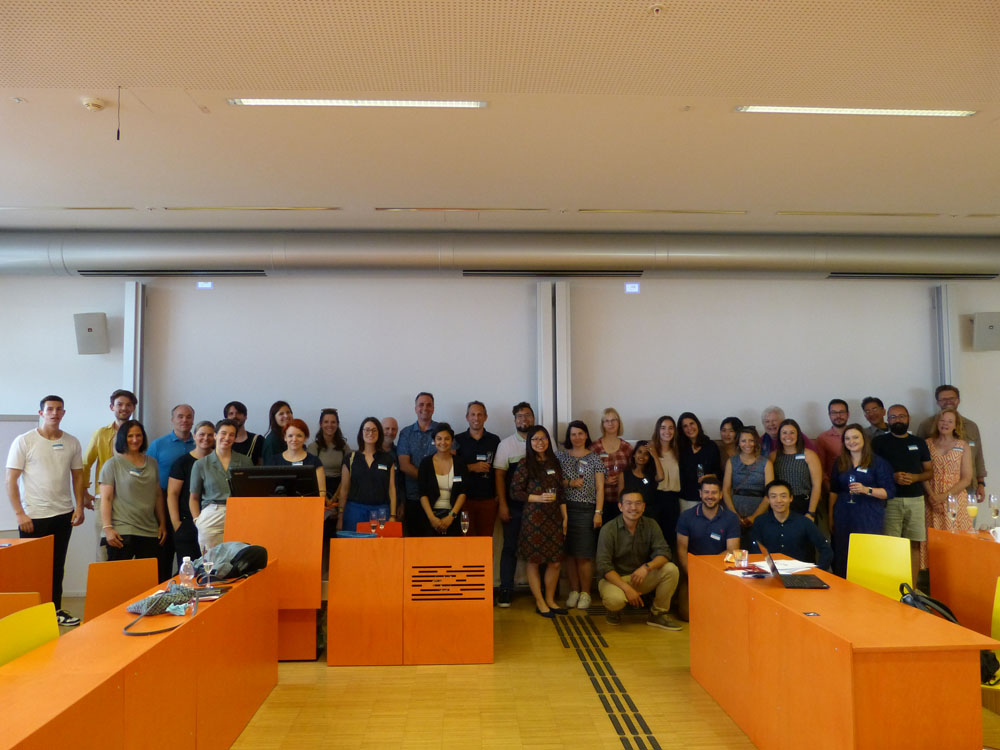
On the 3rd and 4th July 2023, our team hosted an interdisciplinary workshop on ownership research at the WU Vienna University of Economics and Business together with Joann Peck (University of Wisconsin-Madison).
Participants and Organizing Committee of the Workshop
In a rapidly evolving world, the concept of ownership has taken on new dimensions that extend far beyond the traditional legal framework. To delve deep into the intricacies of ownership and its related concepts, a thought-provoking workshop was recently held, bringing together over 30 international experts from 25 renowned universities across 9 countries. The workshop provided a captivating platform to exchange expertise and unravel the manifold manifestations and consequences of ownership, possession, and sharing.
A holistic exploration
The workshop embraced a holistic perspective that delved into the psychological and sociocultural underpinnings of ownership. With a diverse array of experts ranging from psychologists to economists, the workshop was poised to deliver a comprehensive understanding of ownership that transcends geographical and disciplinary boundaries. Over the course of two days and eight sessions, discourses set around diverse topics, such as neurological and physiological indicators of ownership, ownership in marketing, digital ownership and privacy issues, as well as psychological ownership and the environment. Ideas and research findings were presented and exchanged in regular talks as well as blitz talks, that enabled a constructive debate on preliminary findings and novel research ideas.
Perspectives on Ownership
On the first day of presentations, we started the workshop by delving into key insights regarding ownership (Session I: “Insights on the concept and the construct”). We engaged in discussions about feelings of ownership and their influences (Session II: “ ’Who’ matters – Mine vs. Yours vs. ours vs. Theirs”). Moving on to the third session, we explored neurological investigations and physiological indicators, along with the impact of product size on psychological ownership (Session III: “From neurology to physiology”). Concluding the first day, we delved into the role of psychological ownership in marketing (Session IV: “Ownership in marketing”).
Impression from the first day of the workshop
On the second day of the workshop, our discussion revolved around the implications of digital technology on ownership and sharing (Session V “ ’Digital’ matters”). We explored the connection between data, privacy, and ownership (Session VI “Data & Information) and we delved into the realms of collecting and consequences of choice (Session VII: “Consequential insights”). Lastly, we examined the concept of psychological ownership in relation to nature and relevant infrastructure (Session VIII: “ ‘World’ matters: Psychological ownership and the environment”).
Impression from the second day of the workshop
Fostering Connections Beyond Sessions: Inspiring Conversations in Social Settings
The rich tapestry of insights woven during the workshop wasn’t confined to the formal sessions alone. A series of well-curated social events provided the perfect backdrop for participants to unwind, exchange ideas, and forge meaningful connections. The experience began with a vibrant get-together prior to the workshop, setting the tone for the days ahead. This informal setting laid the foundation for the great exchange that would define the workshop’s atmosphere.
A guided walking tour allowed participants to discuss their ideas further while exploring the beautiful city of Vienna and the following workshop dinner provided an opportunity to explore ideas from different angles and learn new facts about ownership in a pub quiz. The casual, relaxed environment of these events fostered an atmosphere of shared learning and discovery.
Guided walking tour
Ownership – Reloaded
The workshop ended with a closing session that stimulated critical thinking about a number of key trends and questions that emerged during the workshop. In a world where the boundaries of ownership are continuously being redrawn, this international workshop stood as a testament to the power of collaboration and interdisciplinary exploration. The dialogue and insights generated will undoubtedly leave a lasting impact on how we perceive, study, and navigate the complex terrain of ownership, possession, and sharing in the modern era.
How anthropomorphism attenuates the effect of psychological ownership on product‐to‐self judgment
When we own a product, it’s not uncommon to feel a sense of connection and identification with it. Consumers may even judge themselves by assimilating the characteristics of products they own. For instance, someone owning an innovative smartphone might feel more innovative.
In their recent study, Zhang (Renmin University of China), Zhou (Renmin University of China), and Yan (NYU Shanghai) sought to explore whether product‐level variables could impact product‐to‐self judgment. They aimed to understand why consumers tend to integrate certain products with the self while excluding others, even when experiencing psychological ownership of the product.
Through a series of three experiments, the researchers shed light on the interplay between psychological ownership, product anthropomorphism, and consumer self-perception. They found that the product-to-self judgment effect does not hold for anthropomorphized products: Consumers are less likely to categorize anthropomorphized products as part of the “Self.” Instead, they view these products as entities separate from their own self.
You can read more about the research of Zhang, Zhou, & Yan (2023) here.
The concept of psychological ownership of nature, or the feeling that nature is “mine” or “ours,” has gained significant attention in recent years as a way to encourage pro-environmental behaviors. However, until now, there has been a lack of psychometrically validated measures to assess this construct accurately, limiting its potential impact in research and practical applications.
Xiongzhi Wang, Kelly S. Fielding, and Angela J. Dean address this gap in their recent paper (published in the Journal of Environmental Psychology) by developing and validating scales to measure individual and collective psychological ownership of nature, using a representative sample of Australian adults.
Different to other approaches measuring feelings of psychological ownership, their measure did not capture the associated attributes of ownership feelings toward nature (e.g., control, intimate familiarity), but rather directly assessed the ownership core (i.e., “mine-ness/our-ness”). The authors developed and validated scales of both individual (“Nature is mine”) and collective psychological ownership of nature (“Nature is ours”). Their results also indicate that these two forms of psychological ownership may have different affects on pro-environmental behaviors, as collective psychological ownership was more strongly associated with environmental concern and environmental self-identity and individual psychological ownership was more strongly associated with territoriality and dominionistic beliefs toward nature. Both scales offer a new tool for researchers interested in understanding psychological ownership and promoting pro-environmental behaviors.
You can read more about the research of Wang, Fielding, & Dean (2023) here.



 The Science of Ownership